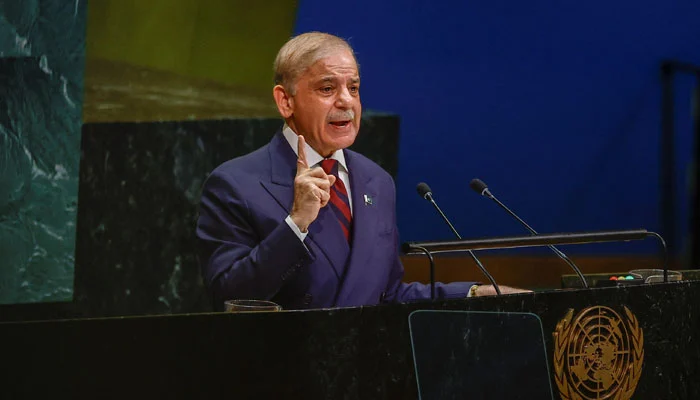
At the UN General Assembly, Pakistan PM Shehbaz Sharif revived Kashmir and Indus Waters Treaty issues, while India rejected his narrative and reiterated its position on terrorism and Jammu and Kashmir
By: Javid Amin | 26 September 2026
New York: Pakistan Prime Minister Shehbaz Sharif has used his address to the 81st session of the United Nations General Assembly to put Kashmir and the Indus waters dispute back at the centre of Islamabad’s diplomatic messaging, warning that any attempt to stop, impede or divert Pakistan’s share of the Indus river waters would be treated as an “act of war”.
Sharif also described Kashmir as Pakistan’s “jugular vein” and called for what he characterised as a just and fair resolution of the dispute.
His remarks came at a particularly sensitive moment in India-Pakistan relations, with the Indus Waters Treaty already caught in a major legal and diplomatic dispute following India’s decision in April 2025 to place the agreement in abeyance.
The speech also revisited the 2025 military confrontation between the two nuclear-armed neighbours, with Sharif presenting Pakistan’s version of those events and crediting US President Donald Trump with helping prevent a wider conflict. India has rejected the account of third-party intervention and has separately challenged Pakistan’s narrative on terrorism and Kashmir.
Water becomes the sharpest warning
The strongest part of Sharif’s speech concerned water.
Describing the Indus river system as vital to Pakistan and the wider region, the Pakistani prime minister warned that any effort to interfere with Pakistan’s share would have consequences beyond a conventional diplomatic disagreement.
“Any attempt to stop, impede, or divert Pakistan’s share of the waters will be treated as an act of war,” Sharif told the UN General Assembly.
The statement was significant because the disagreement is no longer confined to technical questions concerning dams, hydroelectric projects and river flows.
The two countries now disagree fundamentally over the legal status of the treaty itself.
Pakistan continues to maintain that the Indus Waters Treaty remains fully operational and binding. India, meanwhile, says its decision to hold the treaty in abeyance remains in force.
That difference has turned a decades-old water-sharing arrangement into one of the most sensitive elements of the current India-Pakistan relationship.
What is the Indus Waters Treaty?
Signed in 1960 after negotiations involving the World Bank, the Indus Waters Treaty divided the six major rivers of the Indus basin between India and Pakistan while also allowing specified uses by both countries.
Broadly, the three eastern rivers, Ravi, Beas and Sutlej, were allocated for unrestricted use by India, while Pakistan received the western rivers, Indus, Jhelum and Chenab, subject to specified provisions allowing India certain uses including hydropower generation, irrigation and other permitted activities.
The treaty also established mechanisms for dealing with disagreements.
These include the Permanent Indus Commission, a Neutral Expert mechanism for certain technical differences and, in specified circumstances, a Court of Arbitration.
For decades, the agreement survived wars, political crises and repeated disputes over Indian hydroelectric projects on the western rivers.
That history is one reason the present confrontation over its status has attracted international attention.
Why did India put the treaty in abeyance?
India announced its decision to place the Indus Waters Treaty in abeyance in April 2025 following the Pahalgam terror attack, which killed 26 people.
New Delhi has linked the continuation of the measure to Pakistan ending what India describes as support for cross-border terrorism.
India’s position is that the treaty will remain in abeyance until Pakistan credibly and irrevocably ends such support.
Pakistan rejects that position and argues that India cannot unilaterally suspend the treaty on the grounds it has cited.
That disagreement has now moved into international legal proceedings as well as diplomatic exchanges.
The Hague ruling adds another layer
A major development occurred on August 31, 2026, when a Court of Arbitration operating under the Permanent Court of Arbitration issued an award concerning the status of the Indus Waters Treaty.
The court concluded that the treaty remained in force and that the grounds cited by India did not justify its suspension or termination under the treaty or applicable international law. It also issued interim measures concerning the Ratle hydroelectric project in Jammu and Kashmir.
Pakistan welcomed the ruling and presented it as confirmation of its position.
Islamabad has argued that the decision reinforces the treaty-based system for dealing with disagreements over the Indus basin.
But the legal development did not settle the political dispute.
India rejected the ruling, saying it has never recognised the Court of Arbitration in question and that the body was improperly constituted. New Delhi said the court had no jurisdiction over India’s sovereign decisions and reiterated that its decision to hold the treaty in abeyance remains in force.
This creates an unusual situation in which the court and Pakistan describe the treaty as continuing to operate, while India rejects the tribunal’s jurisdiction and maintains its own position on abeyance.
Kashmir returns to the centre of Sharif’s UN message
Water was not the only issue Sharif raised.
The Pakistani prime minister again placed Kashmir at the heart of his speech, describing it in deeply political terms and arguing that lasting peace in South Asia requires a resolution of the Kashmir dispute.
Sharif said Kashmir “has and always will be Pakistan’s jugular vein” and repeated Pakistan’s longstanding call for what it describes as a just settlement based on the aspirations of Kashmiris. He also referred to Pakistan’s demand for a UN-backed plebiscite.
Pakistan has repeatedly raised Kashmir at the UN, while India has consistently rejected Pakistan’s claims and maintained that Jammu and Kashmir is an integral part of India.
The competing positions have remained unchanged despite changes in governments, military leadership and diplomatic circumstances.
What has changed is the wider environment in which the dispute is now being discussed.
Kashmir, terrorism, the Indus waters and the possibility of renewed India-Pakistan confrontation are increasingly being discussed together rather than as separate issues.
Sharif also revisited the 2025 military confrontation
Sharif used his UN address to revisit the military confrontation between India and Pakistan in May 2025.
Pakistan’s prime minister described the confrontation through Islamabad’s interpretation of events and said Pakistan had exercised its right of self-defence.
He also thanked US President Donald Trump for what he called timely intervention, arguing that Washington’s involvement helped prevent the confrontation from escalating into a much wider war.
India has consistently rejected the suggestion that a third party brokered the ceasefire, maintaining that the cessation of hostilities followed direct communication between the Indian and Pakistani militaries.
The disagreement over what ended the 2025 fighting is therefore another unresolved element in the competing diplomatic narratives.
India’s response: terrorism remains the central issue
India’s response at the UN shifted the focus from Kashmir and water to terrorism.
External Affairs Minister S. Jaishankar, speaking at the General Assembly on September 26, criticised what he described as attempts to normalise terrorism and claim immunity from its consequences.
Without naming Pakistan directly, Jaishankar said governments supporting terrorism must be held accountable and reiterated India’s right to defend itself against terrorism.
The response reflected New Delhi’s broader diplomatic position that terrorism and cross-border violence must be addressed before any meaningful normalisation of relations with Pakistan can take place.
Indian officials have also continued to reject Pakistan’s description of Kashmir and its claims concerning the 2025 conflict.
Thus, the two sides are not merely disagreeing over individual facts.
They are presenting fundamentally different explanations of the relationship itself.
Why the water dispute matters beyond Kashmir
The Indus issue carries an economic and strategic significance that goes beyond diplomatic rhetoric.
Pakistan’s agricultural economy depends heavily on the Indus Basin irrigation system. The World Bank has described the treaty as a framework governing the use of the Indus river system and noted that the agreement survived repeated periods of India-Pakistan tension.
That makes water security an especially sensitive subject in Pakistan.
For India, however, the western rivers are also linked to development and hydropower projects in Jammu and Kashmir.
The treaty does not simply prohibit India from using the western rivers. It permits specified forms of use, including hydroelectric generation, subject to treaty conditions.
This distinction is important because political statements about “stopping” or “diverting” water can obscure the technical reality of the treaty.
A dispute over the design or operation of a hydropower project is not automatically the same thing as a complete diversion of a river.
The legal and engineering questions surrounding individual projects are considerably more complicated.
The Ratle and Kishenganga disputes show how technical the issue can become
For years, Pakistan has challenged aspects of Indian hydroelectric projects on the western rivers.
The treaty contains detailed provisions governing Indian hydroelectric projects, including design requirements and procedures for resolving technical disagreements.
The Court of Arbitration proceedings have dealt with questions involving projects such as Kishenganga and Ratle.
The August 2026 award also addressed interim restrictions concerning construction at Ratle while a separate Neutral Expert process continues.
The existence of multiple dispute-resolution mechanisms demonstrates why the Indus dispute cannot be reduced simply to the question of whether one country can “turn off” another country’s water.
The treaty contains an elaborate legal and technical structure precisely because river management involves seasonal flows, storage, hydropower, irrigation and downstream requirements.
A treaty that survived wars now faces a different test
One of the most striking aspects of the current dispute is the history of the treaty itself.
The Indus Waters Treaty was signed in September 1960 after nearly a decade of negotiations facilitated by the World Bank. It subsequently survived the India-Pakistan wars and numerous diplomatic crises.
That durability made it unusual among international agreements between the two countries.
The present crisis is different because the disagreement concerns not merely the interpretation of particular provisions but the treaty’s continuing legal and political operation.
Pakistan says the treaty remains binding.
An international arbitration panel has reached the same conclusion.
India rejects the panel’s jurisdiction and says its decision to hold the treaty in abeyance remains in force.
Until that fundamental disagreement is resolved, every major statement on Indus waters is likely to carry a security dimension.
Why Sharif’s “act of war” warning matters
Sharif’s warning does not itself create a new legal definition of an act of war.
It is a political and diplomatic warning issued by Pakistan’s prime minister.
Its significance lies in the message it sends about how Islamabad views any substantial change to water flows.
The language also raises the stakes at a time when India and Pakistan remain nuclear-armed states with unresolved disputes over Kashmir, terrorism and the interpretation of the 2025 conflict.
For Pakistan, the Indus is directly connected to agriculture, food security and economic stability.
For India, the treaty is now linked to national security, counterterrorism and its rights over water and infrastructure in the western river system.
That intersection makes the dispute particularly sensitive.
Kashmir and water are now moving together in the diplomatic conversation
For decades, Kashmir and the Indus Waters Treaty were often handled through different diplomatic channels.
The latest UN exchange shows how closely they are now being linked in political messaging.
Sharif connected a resolution of the Kashmir dispute with preventing another major India-Pakistan confrontation.
He placed the Indus waters issue alongside that broader security argument and warned against using water as a strategic instrument.
India’s response, meanwhile, placed terrorism at the centre of its argument and maintained that the consequences of cross-border terrorism cannot be separated from bilateral relations.
The result is a diplomatic conversation in which Kashmir, terrorism, water and military escalation increasingly overlap.
The unresolved question is what happens next
Sharif’s UN warning is unlikely, by itself, to resolve the underlying treaty dispute.
Neither will India’s rejection of the arbitration ruling settle Pakistan’s objections.
The immediate challenge is therefore less about rhetoric and more about whether the two countries can find a mechanism through which their competing legal, security and water-management positions can again be addressed.
The Indus Waters Treaty was designed to create such mechanisms.
The present crisis is testing whether those mechanisms can continue to function when one party disputes the authority of the process itself.
For South Asia, the stakes are larger than the language exchanged at the UN.
The Indus basin crosses one of the world’s most politically sensitive borders. Millions of people depend on its waters, while India and Pakistan remain divided over Kashmir and security.
That is why Sharif’s phrase “act of war” has attracted attention.
It is not simply a warning about water.
It is a reflection of how deeply water, security and the Kashmir dispute have become intertwined in India-Pakistan relations.